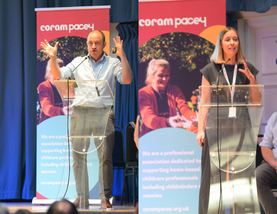
Home-based childcare may be small in scale, but as the panel of practitioners made abundantly clear, its impact is vast. At the recent Coram PACEY conference, a group of deeply committed childminders, nannies and assistants came together to share what makes this form of early years provision so uniquely powerful. Their stories revealed a sector defined by relationships, resilience and an unwavering belief in children’s potential.
By Zara Smith
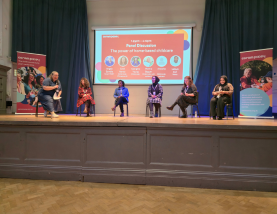
Knowing children “inside out, upside down and back to front”
Opening the discussion, Georgina Young, childminder captured what lies at the heart of home-based practice: depth of knowledge. Providers spend years, often from babyhood to school age, with the same children. That time builds a profound understanding that simply cannot be replicated in larger, more structured settings.
It’s more than knowing favourite colours. It’s recognising the difference between a tired cry and an overwhelmed one; reading the meaning behind a child’s silence; knowing when joy is blossoming or fear is rising. This attunement settles a child’s nervous system and when a child feels safe, they can explore, imagine and learn.
Home-based environments also offer something precious in a fast-paced world: space to slow down. If a child wants to spend twenty minutes following a ladybird or spontaneously bake together, practitioners have the flexibility to honour that moment of curiosity. It is care rooted in the rhythm of the child, not the timetable.
Nannies: leading practice within the family home
Working in a family’s private space brings a unique dynamic. As nanny Latoya Zuri explained, despite being technically an employee, parents often look to them for guidance, routines and expertise. Professionalism is essential. Clear boundaries around time, expectations and communication help build trust.
Over time, families learn that nannies are not simply fulfilling tasks: they are shaping children’s daily experiences with intention, knowledge and a strong understanding of development. It is a partnership, but one that thrives when nannies step confidently into their professional role.
Challenging misconceptions: The “early years chief everything officer”
Monira’s contribution was both humorous and deeply resonant. She argued that the job title “childminder” doesn’t come close to capturing the reality of the role instead suggesting that EYCEO: Early Years Chief Everything Officer would be more appropriate.
Home-based providers are planners, chefs, first aiders, educators, SEND spotters, report writers, business owners, accountants and emotional anchors. They are often the first to identify developmental differences and the last to switch off, responding to parents long past official hours.
Yet despite this complexity, childminders often undersell their own professionalism. Monira’s message was clear: before the public can value the sector, the sector must value itself. Pride, advocacy and visibility are essential.
A pathway for the next generation
Aroosha’s journey into childcare began almost by accident – a flexible college job as an assistant for Monira that became a calling. Through her work as a childminding assistant, she discovered not only a love for supporting children but also a foundation that shaped her wider career: youth work, anti-discrimination workshops, and now a future that blends her law studies with her early years’ experience.
Her story reflects the life-changing influence of home-based settings, not only on children but on the adults who grow within them.
Adapting for children with SEND in wraparound Care
Carol Kerrey, childminder, offered powerful examples of inclusive practice in a busy wraparound environment. Working with children from age three to twelve, she described long-term relationships where continuity is central, whether supporting a child transitioning to secondary school, managing sensory overwhelm during pancake day, or providing consistency during emotionally difficult pick-up and drop-off routines.
Each case highlighted the same truth: for children with additional needs, stability and familiarity are transformative. And home-based childcare can offer those elements in abundance.
What practitioners gain: connection, purpose and lifelong impact
In their closing reflections, panel members shared what home-based childcare has given them personally. Common threads emerged:
- Deep relationships with families that make a tangible difference in their lives.
- The privilege of witnessing children’s long-term growth from babies to confident young people.
- The joy of receiving love and trust back from children, a reward no salary can match.
- The satisfaction of shaping childhoods in ways that stay with children for life.
Perhaps most poignantly, they spoke of the invisible recognition in their work not from regulatory bodies, colleagues or parents, but from the children who return, sometimes years later, to say: “You mattered.”
Time: the irreplaceable ingredient
As Georgina summarised so powerfully, the defining feature of home-based childcare is time; time to notice, time to respond, time to connect, time to truly see who children are becoming. No other childcare model replicates that depth of continuous, relational care.
In a sector often challenged by workload, policy shifts and public misunderstanding, the event was a reminder of something vital: home-based childcare professionals are a cornerstone of early childhood development. Their work shapes the architecture of children’s lives, their confidence, their sense of worth and ultimately, their future.
And as the sector moves forward into consultations and reforms, one message rang out clearly: home-based care is not only essential but under-recognised, underutilised and deserving of far greater visibility.