By Zara Smith
Understanding Ofsted’s renewed early years inspection approach
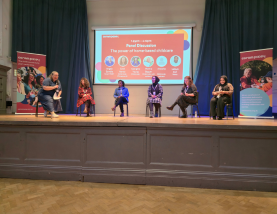
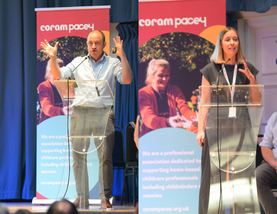
The Ofsted workshop at the recent Coram PACEY conference offered a detailed walkthrough of the renewed inspection framework, with a strong focus on transparency, consistency, and recognising the vital work childminders do every day.
Recognising the importance of childminders
The session opened with a heartfelt acknowledgement of the essential role childminders play in children’s early lives and learning. Ofsted emphasised their appreciation for the professionalism and dedication shown across the sector, highlighting the unique relationships childminders build with families and the impact they have on children’s wellbeing and development.
Using local data to understand your context
Inspectors will now begin by reviewing publicly available local area data, such as deprivation levels, EYPP take-up, oral health and obesity figures, to understand the community context you work in. This is only a starting point for discussion; you are not expected to know or interpret this data yourself.
Notification and planning
A significant change has been introduced with the addition of a planning call. You will still receive notification of your inspection up to five working days in advance. Inspectors will arrange this planning call at a mutually convenient time, aiming to avoid busy periods wherever possible.
During the planning call, you and the inspector will discuss key areas such as your curriculum, the needs of your children, inclusion, and daily routines. The familiar “learning walk” (or “learning sit” for childminders) will no longer take place, as the planning call now serves this purpose.
Choosing the inspection day
For the first time, childminders will know exactly which day the inspector will visit. The day will be agreed so inspectors can observe children from key groups, such as those with SEND, children known to social care, or those facing socioeconomic disadvantage.
What inspectors focus on
Inspections aim to:
- celebrate your strengths,
- understand children’s lived experience in your setting,
- validate your priorities,
- and identify areas for improvement.
Most evidence comes through shared observations and ongoing professional dialogue, an approach designed to feel collaborative rather than evaluative.
Inspectors will track a sample of children’s experiences, focusing especially on those with barriers to learning or wellbeing.
Understanding the evaluation areas
Ofsted’s evaluation areas mirror the EYFS and include:
- curriculum and teaching
- achievement
- behaviour, attitudes and routines
- children’s welfare and wellbeing
- leadership and governance
- safeguarding (graded as met or not met)
Childminders caring only for children before/after school will not be evaluated on curriculum and teaching or achievement, because the EYFS learning and development requirements do not apply in these cases.
How grading works
The new five-point scale moves away from the old single overall judgement. You may now receive different grades across different evaluation areas.
Expected standard
This is the middle grade but represents a high bar. Meeting the expected standard means you are:
- meeting all EYFS requirements,
- delivering high-quality care and education,
- achieving what Ofsted expects for every child, in every part of the country.
Ofsted are keen to emphasise that expected standard is something to be proud of, not a downgrade.
Strong standard
This indicates consistently strong practice that exceeds expectations.
Exceptional
Exceptional is for rare, truly transformational practice. Inspectors will not expect you to aim for exceptional, nor will they work through the grades mechanically. Instead, if they observe worldclass, innovative practice with significant impact, they will consider this grade.
Concerns were raised about fairness, especially for singlehanded childminders, and Ofsted reiterated that exceptional does not replace “outstanding” and is absolutely not intended to be unattainable.
Needs attention and urgent improvement
- Needs attention means at least one area is not a secure fit for expected standard. This triggers a reinspection within 12 months.
- Urgent improvement or safeguarding not met will result in reinspection within six months.
Inclusion and barriers to learning
Ofsted pointed out that they now place stronger emphasis on understanding children’s barriers to learning, whether that is SEND, social care involvement, socioeconomic disadvantage, or short-term challenges such as illness, family changes or emotional stress. Childminders were assured this approach is not designed to disadvantage them and reflects the real range of needs children may present with.
Complaints and accountability
Ofsted are keen for all childminders to understand that:
- complaints are taken seriously,
- they do lead to changes in reports and grades,
- investigations are carried out independently,
- inspectors involved in the next visit will not know a complaint was made.
Childminders at the workshop emphasised that confidence in the complaints process needs rebuilding, and Ofsted committed to improving communication.
Food, nutrition and policy changes
Questions were raised about the new early years nutrition guidance. Ofsted confirmed they:
- are monitoring the impact,
- are not the “lunchbox police”,
- wish to ensure inspectors apply expectations with common sense.
Where needed, concerns will be raised with the DfE.
Supporting the childminding profession
Throughout the session, Ofsted leaders emphasised their longstanding support for childminders and the importance of raising public understanding of childminding as a high-quality early years option. They also discussed plans to create more resources tailored for childminders, including clearer communication for parents.
Final thoughts
The renewed inspection framework aims to:
- be more transparent,
- recognise the diverse realities of early years settings,
- champion children’s needs,
- and give parents a clearer understanding of strengths and priorities.
For childminders, the message is clear: expected standard is a strong achievement, your context matters, and Ofsted wants inspections to feel more collaborative than ever.