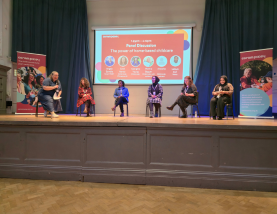
After a jam-packed day full of learning and inspiration at the Coram PACEY conference, the words of two neuroscientists have continued to reverberate around my brain, prompting me to reflect upon my own practice.
Prof. Sam Wass and Dr. Gemma Goldenburg’s session contained a whole host of practical tips to help practitioners unlock that ‘Goldilocks zone’ of learning, when all the conditions are just right for young brains to absorb and process new information.
By Amy Jordan
How do brains actually learn?
Their session began by suggesting it is most helpful to think about the brain as a prediction tool, always looking to anticipate what word is coming next in a sentence, or what a food tastes like. As humans, we learn best when we can predict what will happen sometimes but not always – just the right mix between an experience being too predictable and too unpredictable.
This is very difficult as a newborn baby with no prior knowledge! With every new experience, the brain’s neural connections grow stronger and more efficient, firing specific neurons relevant to the task and pruning unused connections. The brain is then more able to make predictions about what will happen based on that prior knowledge, and whether or not this was an accurate prediction in turn updates that base of knowledge. This activity is at its busiest between the ages of 2-5, meaning this is an incredibly important window when the opportunity to learn is maximised.
Tip 1: The importance of repetition
For young brains with limited prior knowledge, repetition is therefore crucial to accessing the Goldilocks zone. The first experience of something is too unpredictable for the child’s brain to fully process the information; repeating the experience a second time will move the brain closer to the optimal conditions for learning to take place. With each repetition, the brain improves at predicting what’s coming next, and eventually will stop releasing as much dopamine as the learning is consolidated and the child’s interests move on.
To muster the patience to pick up the dropped spoon for the 1000th time, Wass and Goldenburg encourage noticing the learning going on beneath this repetitive action; if a child is still repeating something, they are still learning. This also means practitioners do not need to fill the day with new things every hour; rather, being able to engage with the same experiences day in, day out, provides the best opportunity for over learning and mastery.
Tip 2: Rhythm matters
Brains are wired to pay attention to regular rhythms, and a brain finds it even easier to tune in to these when accompanied by physical movements, eg. Nursery rhymes with actions. Singing these rhymes in a group at the same time is even more powerful, as it builds feelings of interconnectedness and strengthens relationships.
The rhythm of the day is also important; having a daily routine and keeping it the same means the brain can anticipate and prepare for the transitions it faces.
All of these efforts help to nudge the messy rhythm of a young child’s brain towards a more stable, adult-like rhythm.
Tip 3: Keep things as clear as possible
The younger the child, the quieter the environment needs to be to hear speech clearly. It is not until around 12-13 years old that a brain becomes able to disentangle noises effectively in a loud environment – some toddlers can struggle to recognise their own name with speech in the background. This can negatively impact their language acquisition and later reading development. Reducing background noise and turning off TVs or radios will really help.
Wall displays should be as basic and simple as possible. For 85% of children, wall displays are a distraction. A child’s brain does not yet know what it needs to focus on and what it can ignore, so valuable energy is taken up processing what is displayed in the environment that detracts from their ability to learn. Keep areas clutter free to help a child know what they should be focusing on.
In books or resources, images and illustrations should be as simple as possible in order not to overload the brain’s processing capabilities. This allows a clear audio and visual signal to be received by the brain without distractions.
Tip 4: Slow down
Adults can process 10 frames per second, whereas a 15 month old can only process 1 frame per second – 10 times slower than an adult. Slowing down the pace of your speech, reading, singing, reactions and transitions will significantly help the child’s ability to process what is happening. Try letting them set the pace – plan your day to minimise rushing and hurrying.
In summary, the youngest brains need repetition, rhythms, clarity and slow pace from practitioners. With these in place, the child is more likely to be able to access their Goldilocks zone of optimal learning conditions – although as this zone continually progresses, be prepared to continue adapting!