by Zara Smith. Writer/Editor, Coram PACEY
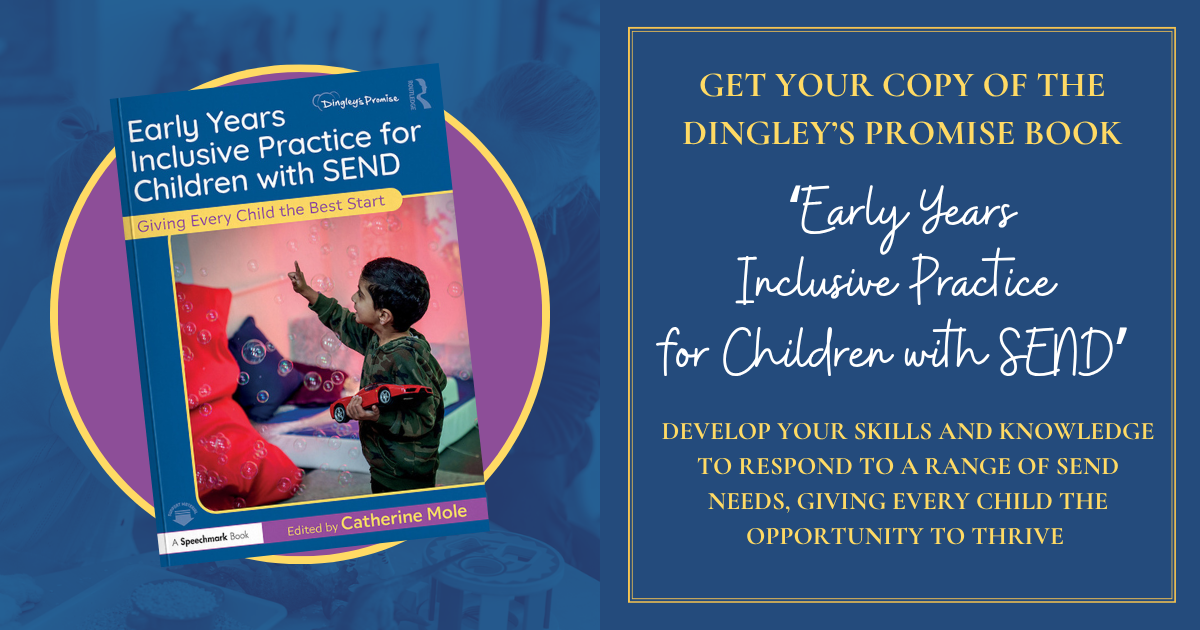
Early Years Inclusive Practice for Children with SEND: Giving Every Child the Best Start by Dingley’s Promise is a practical and reassuring book that places inclusion at the heart of early years practice. From the outset, it feels grounded in the realities of practice rather than theory alone, which makes it especially relevant for practitioners who want guidance that is realistic, reflective, and immediately useful. The book presents inclusion not as a separate task to be added on when time allows, but as an essential part of quality early years provision, woven through the daily rhythms of care, learning, planning, and relationships.
One of the book’s most appealing qualities is its clear and reassuring tone and its greatest strengths is its use of real-life case studies from practice. It speaks to practitioners in a way that feels encouraging rather than overwhelming, which is important when discussing SEND, an area that can sometimes feel complex or daunting. It strikes a careful balance between being informative and being practical, offering readers enough explanation to understand key ideas while avoiding unnecessary jargon making it a book that is likely to be welcomed by a wide audience, including childminders, nursery practitioners, students, early years leaders, and anyone seeking to strengthen their confidence in inclusive practice.
The case studies examples help bridge the gap between principle and practice by showing what inclusion can look like in everyday settings. Rather than presenting SEND as something abstract or distant, the book brings it into the lived experience of early years practitioners, where small adjustments, sensitive observation, and thoughtful responses can make a real difference. This practical grounding makes it feel useful for readers who are looking for ideas they can take straight back into their own settings.
The book also offers a strong reflective dimension, which does more than provide answers; it invites readers to pause, consider their current approaches, and consider what they might develop and improve their practice. It encourages practitioners to think about their own environments, routines, and relationships, and to consider how these can either support or unintentionally limit a child’s participation. That kind of reflection is vital in early years, where inclusion is often shaped by everyday interactions rather than by large-scale interventions alone.
Throughout the book there is an emphasis on small changes that have a big impact. This is a particularly helpful message for busy practitioners, because it avoids presenting inclusion as something that depends solely on specialist resources or complex strategies. Instead, it recognises that inclusive practice is often built through ordinary but meaningful actions: adapting language, noticing patterns in children’s behaviour, making environments more predictable, building secure relationships, and responding flexibly to individual need. In that sense, the book offers a powerful reminder that inclusion is practical, relational, and achievable.
The focus on belonging also stands out. Effective inclusive practice is not only about supporting development or meeting identified needs; it is about ensuring that every child feels valued, understood, and able to take part. This wider lens is important because it helps practitioners see SEND through the experience of the child, rather than through systems and categories alone. That perspective can shape more compassionate, child-centred practice.
I feel that the book looks would be particularly useful for readers who are still building confidence in SEND or who want to revisit core inclusive principles in a straightforward and encouraging way. It may also be valuable as a reflective team resource, prompting discussion about how settings can improve environments, communication, planning, and relationships. For leaders, it could support wider conversations about culture and ethos, helping to reinforce the idea that inclusive practice belongs to everyone, not just the setting’s SEND lead.
This is an accessible and thought-provoking guide that reminds readers that true inclusion begins with everyday practice.