Pat Tomlinson, Coram PACEY Advisor.
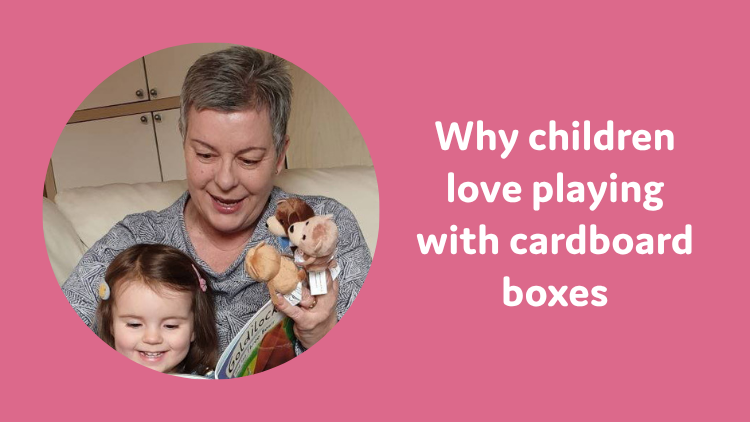
Earlier this week I came across a book that was a favourite with several children I used to care for. It’s a well-loved book that in places is just about holding together by a thread. Unfortunately, it seems to have gone out of print and to buy a used copy is more than the original price.
The book is called Box by Min Flyte and Rosalind Beardshaw. The author describes the story as “When four toddlers find some toys in cardboard boxes, they have fun with them for a while. But, before long, the friends’ interest in the toys wanes and their attention turns to the boxes themselves. What could they do with SO many boxes, they wonder?”
This got me thinking – how often do children prefer the box to the toy inside the box? Some time ago my paper re-cycling bin was full, and I had lots of boxes (too many home deliveries), so needed to store them until after the next re-cycling collection. Inevitably, my three year old granddaughter (we’ll call her F) found my stash of boxes and wanted to play with them. Of course I said yes, let’s see what you can do with them? Some of the smaller boxes became beds for the dolls and teddies and another became a treasure box to hide away from the pirates.
There was a large box, and I wondered what F would do with it. She turned it upside down and got inside it. I thought “oh, she’s wanting to play hide and seek yet again”. F usually wants to play hide and seek but tells you where to hide! Next thing I knew, one hand peeped out, followed by one foot, then the other hand and foot and the box moved. A little voice said, “I’m a turtle” and the box slowly moved around the room. I’ve seen children use boxes to make trains, tall towers, containers to move dolls and soft toys around the room etc, but being a turtle was a first for me.
It was such a magical moment for me, so I wanted to share it. It also reminded me that we may be dazzled with web pages of wonderful resources, ideas on Pinterest and photos of settings on social media, but often, given a choice, what does a child want? A cardboard box and lots of imagination.


What do children learn from playing with boxes?
- Communication and language – lots of opportunities to talk about what the box has become. Maybe relating it to the box book.
- Physical development – gross motor skills when moving around like a turtle or when building a tower with lots of boxes.
- Personal, social and emotional development – co-operating with others, feeling of self-worth especially when getting a positive response from adults about their achievements.
- Literacy – looking at and reading the book about boxes. Relating it to the box activities.
- Mathematics – understanding shapes and size – can I get inside the box? counting the boxes.
- Understanding the World – discovering where boxes come from, how they are used and can be re-used, then re-cycled.
- Expressive arts and design – using the boxes in many different ways – a cot, a train, a turtle. It’s developing a child’s imagination and creativity.
Characteristics of effective learning
- Playing and exploring – F was investigating and “having a go” to see what she could do with the boxes
- Active Learning – I could see the concentration when F was planning on what to do with the boxes and her enjoyment when she achieved her objectives (plus the positive reaction from the adults)
- Creativing and thinking critically – F had lots of her own ideas on what she was going to do with the boxes and didn’t want any adult intervention (or suggestions). She worked out her own strategies on how to achieve her goal (what she was making with the boxes)
To find out more, have a look at the Coram PACEY factsheet on Characteristics of effective learning.
Schemas
I’m often fascinated by the many different ways children play and use resources, so I find it useful to look at schemas. In the case of F being a turtle I identified this as being an enveloping schema. Being a turtle is just one of the many ways she plays, covering herself or others (including me!) with blankets, pieces of material etc.
Why not have a look at the Coram PACEY Schema factsheet Schemas factsheet. If you would like further training on schemas, have a look at the Coram PACEY schema course.
Resources
- Following children’s interests and supporting their play – Coram PACEY
- Ideas for creative childcare | Facebook
- Schema course (available in the Coram PACEY shop)
Coram PACEY member resources
- Child-initiated play and adult-led activities
- Imaginative play
- Schemas factsheet
- Childcare Professional magazine Summer 2026 page 31 “Schema play in action” – The Childcare Professional
- Characteristics of effective learning (England)
- CEY Smart course – Creativity and the arts in the early years – exploring the conditions for nurturing creativity in practice
Find out more about becoming a Coram PACEY member, a membership designed to support you and the incredible work you do.