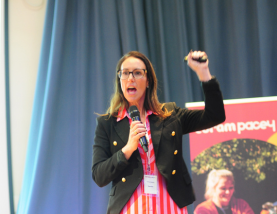
Lucy Lewin delivered an energetic and thought‑provoking session that asked childminders to see themselves not just as carers, but as powerful, skilled business owners. Her message was clear: your work changes lives, and your business model needs to reflect that value.
By Zara Smith
Lucy began by naming the reality many childminders live with but rarely say out loud. It is common to feel financially stretched, emotionally exhausted and physically drained. Long evenings lost to paperwork and learning journeys can leave you wondering whether the work is truly sustainable or “worth it”.
A lucy stated this is not due to a lack of passion – childminders care deeply about children and families. The problem, she argues, is not your heart, but your business model – and that can be changed and adapted
Childminders should see their childminding as a business, not just a vocation – a key shift in focus – helping childminder to understand that the real product they sell is their professional time, in a regulated, high‑quality environment. When childminders view their settings through this lens, they can make clearer decisions about hours, pricing and capacity.
Lucy invited childminders to “step out of your heart and into your head” when making business decisions. Caring is central to what you do, but it cannot be the only thing guiding pricing and planning if childminders want their setting to be sustainable.
Why ratios are not enough
Many childminders are told that having “three under‑fives” automatically makes the business sustainable. Lucy firmly challenges this myth. Simply filling spaces does not guarantee financial security. To build a robust business, childminders must understand:
- their capacity
- how funding actually works in their area
- their different income streams
The unique strengths of childminders
Rather than seeing themselves as “less than” nurseries or schools, Lucy urges childminders to recognise the powerful advantages built into home‑based care. These include:
- Exceptional flexibility that larger settings struggle to match
- Deep relationships, where 100% of the adults know 100% of the children and families
- Small ratios, which parents actively look for and value highly
- High levels of trust, with parents regularly entering your home and seeing the environment first‑hand
- Continuity of care, in contrast to larger settings that may face frequent staff changes
Lucy urges childminders to reframe small ratios not as a limitation, but rather as a premium feature; something that should sit at the heart of a childminders offer, not something to be apologised for.
Costing, pricing and standing firm
Lucy noted that many childminders do not know their true cost per hour. Often, they state that they feel that funding is too low but without knowing their true cost per hour, they cannot say exactly what “enough” would be. Without this knowledge, it is very hard to set confident fees or challenge unfair assumptions.
Her advice is practical and direct: work out your cost per hour, remove guilt and emotion from pricing, and recognise that you are allowed to charge for flexibility, just as people pay more for convenience in everyday life. Data, not guesswork, should drive your decisions.
Enrichment, extras and clear communication
She draws a clear and important line between what funded hours should cover and what sits beyond that. Funded hours, she argues, should cover the basics of the EYFS. Everything on top – trips, special activities, enhanced resources, extra snacks and so on – is enrichment.
If a particular extra costs a childminder money and parents are unwilling to pay for it, as a business childminders have a choice: stop offering it or find parents who value and will pay for what they provide. Clear, honest communication about what is funded and what is an optional extra, helps prevent disputes with local authorities, ombudsmen and families.
Recognise your worth
Lucy closes on an empowering note. She invites childminders to recognise their worth; to stand tall in their professional identity and to honour the impact they have on children and families every single day. She advocated for childminders to speak powerful statements over themselves, “I am shaping futures”. It is a reminder that they are not “just” a childminder. They are an educator, a leader and a business owner whose work changes the course of children’s lives.