
All children learn in their own way and at different rates.
What is SEN?
SEN stands for Special Educational Needs.
A child or young person has SEN if they have a learning difficulty or disability which calls for special educational provision to be made for him or her. A child of compulsory school age or a young person has a learning difficulty or disability if he or she has a significantly greater difficulty in learning than the majority of others of the same age, or has a disability which prevents or hinders him or her from making use of educational facilities of a kind generally provided for others of the same age in mainstream schools or mainstream post-16 institutions.
In Wales, children are referred to as have Additional Learning Needs (ALN). Please see the Wales resource Additional Learning Needs (ALN) Wales/ Anghenion Dysgu Ychwanegol (ADY) Cymru
Statutory guidance
The SEND Code of Practice: 0 to 25 years is a statutory guidance for those who work with and support children and young people with SEND in England. It was been produced alongside the Children and Families Act 2014. Both the Act and the Code of Practice came into effect in September 2014.
The SEND Code of Practice: 0 to 25 years covers the guidance on the special educational needs and disability (SEND) system for children and young people aged 0 to 25.
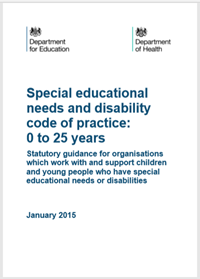
The full statutory guidance includes:
- Reference to the relevant legislation
- The principles in practice
- Impartial information, advice and support for parents, children and young people
- How to work together across education, health and care for joint outcomes
- The local offer
- Early years providers, schools and further education
- Preparing for adulthood from the earliest years
- Education, health and care needs assessments and plans
- Guidance when dealing with children and young people in specific circumstances
- Resolving disagreements
What does the SEND Code of Practice mean for me?
Childminders and early years providers must have arrangements in place to support children with Special Educational Needs and Disabilities (SEND). Childminders and Maintained schools, academies and maintained nursery schools and all providers who are funded by the local authority to deliver early education places are required to have regard to the 0-25 SEND Code of Practice. Other childminders and providers may find it helpful to familiarise themselves with the early years section of the 0-25 SEND Code of Practice.
Many childcare professionals care for children with special educational needs and/or disabilities (SEND). A child may be diagnosed with a condition before joining your setting, or you may be involved in identifying a special educational need or disability.
Your daily observations and interactions with the children in your care, and the valuable support you offer families, mean that you’re well placed to spot any early signs of additional needs.
The Early years foundation stage statutory frameworks asks childminders and providers to provide parents with a brief written development summary of their child’s progress in the prime areas of learning at age 2. Where possible, the progress check and the Healthy Child Programme health and development review at age two (when health visitors gather information on a child’s health and development) should inform each other and support integrated working.
The integration of these reviews aims to combine the expertise of health visitors and early years practitioners to effectively identify additional needs and provide early support. Having knowledge and understanding of the SEND Code of Practice will help identify and support these needs.
Childminders are encouraged to identify a person to act as a SENCO (SEND coordinator). Childminders who are registered with a CMA, or who are part of a network, may wish to share the role between them. Maintained schools, academies and maintained nursery schools are required to identify a member of staff to act as Special Educational Needs Co-ordinator (SENCO) and other providers (in group provision) are expected to identify a SENCO.
Further guidance can be found in the SEND: guide for early years settings – GOV.UK
Further resources can be found in the Help for early years providers : SEND assessment guidance and resources
Coram PACEY blogs and resources:
- What is the graduated approach and how do I use it? (England only) – Coram PACEY
- Writing a good support plan (England) – Coram PACEY
- Altering assumptions – Coram PACEY
- Wraparound: SEND/ALN – Coram PACEY
Coram PACEY member resources
- SEND Code of Practice factsheet – a free factsheet for members outlining and explaining the SEND code of practice for childcare professionals. This includes key information and advice for supporting a child with SEND, the importance of your setting and how to address clear targets to enable them to reach ambitious outcomes.
- Inclusion factsheet – a free factsheet for members that covers the individual needs of the child and how you can meet them, allowing children to feel equal, respected and valued in your setting.
- Intimate care for disabled children – a free factsheet for members on how to provide intimate care for disabled children.
- Equal opportunities – Offering and promoting equal opportunities in your setting and ensuring you recognise and respect the uniqueness of each child to help them progress.
- Equality and diversity – Ensuring equal opportunities to every child, regardless of their disability and other protected rights.
- Webinar: Understanding neurodivergent behaviours – In this webinar we consider the behaviours we observe in neurodivergent children. Whether they have a formal diagnosis of autism, ADHD, PDA, or you are noticing differences in the children’s responses to sensory input, the environment, or when connecting with others, we will be exploring how best to support them.
- What does inclusive practice look like in early years settings, particularly for those with additional needs?
Special Educational Needs and Disability Coordinator (SENDCO)
The SENDCO’s main responsibility is the day-to-day operation of the setting’s SEN and inclusion policy, which will involve coordinating provision and supporting practitioners in their work with children with SEN.
Other responsibilities of the SENDCO include:
- involving parents with their children’s SEND needs,
- liaising with professionals or agencies beyond the setting,
- arranging, organising, and reviewing support for individual children,
- implementing, monitoring, and reporting on SEN support,
- record keeping,
- securing any funding available to support children with SEN
SENDCOs will also need to take the responsibility for remaining up to date on any legislation changes from the government or their local authority and responding to it, including dissemination of information, training, and changes to practice to colleagues.
Case studies
Cathy's story
Supporting the family of a child with Prader-Willi
Cathy, Childminder in Walthamstow
I was made redundant from a role at the Department for Work and Pensions in 2015, and used this as an opportunity to change my career path completely. I had been considering a switch to become a foster carer for a number of years, and had a keen interest in children’s development. However, at the time my niece was struggling to find the right childcare for her family, and this drove my decision to undertake the relevant training and registration to become a qualified childminder. Once my business was up and running, I took on some vulnerable children who had found it harder to find suitable childcare.
I was approached by a single mother to help provide childcare for her baby, who has the rare genetic condition, Prader-Willi syndrome. Originally from Romania, she was quite isolated and in need of additional support. With no family living locally to help out, she required childcare to enable her to work, and have the necessary respite to provide the best possible home environment for her son.
When I first welcomed Idris into my setting, he wasn’t yet a year old. He displayed many of the symptoms commonly associated with Prader-Willi, including an interest in food, and floppiness caused by weak muscles. Initially I found some of the situations I faced with him quite scary, but his Mum undertook a huge amount of research into the best ways to support her son, and we worked in partnership to build a care routine that worked for Idris. We were both learning as we went, and she was brilliant at sharing everything she found with me. I spent a lot of time reading up on methods I could adopt to make things easier for him.
There were also delays in other areas of his development. Idris didn’t walk until he was three years old, and his speech is well behind what you would expect from a child of his age. But his Mum decided that his Early Years home visitor from the local council should also be involved in the decisions we made about his life outside of her house, and together the three of us built a strong working relationship to ensure his needs were met wherever he was.
One of the most commonly recognised symptoms, excessive appetite, came later for Idris. His Mum gave me a special diet prepared for him and his needs, plus an insight into what was to come. This helped me prepare for the best ways to handle situations when they arose. Idris’s food is still controlled by her, but he now tells me he is hungry. Idris is always thinking about his food, and knows what he is going to have, but I find ways to distract him to make sure he eats at specific times.
My setting became like a second family to him. To the other young children in my care, Idris was one of them. For the slightly older children, I was able to explain what extra help he needed, and what they could do to help him join in or feel included. I run an inclusive practice, and have always made sure that Idris is never excluded from what we’re doing. I honestly believe that there are very few activities and events that cannot be tailored to meet the needs of all children, as long as you give them a little consideration.
On some of the days I have Idris, I have smaller numbers of children to facilitate additional levels of care. For example, I agreed with Mum that I would take him to his music therapy lessons, which he loves, but being able to transport him and participate in the session means giving him 1-to-1 care. I am also extremely fortunate to be part of a local group of wonderful childminders. Together, we attend playgroups and organise meet-ups, where we’re all supporting each other, and making sure that the fun and learning opportunities we provide are accessible to all. We’ve even helped raise money to support Idris’s medical requirements.
Idris is four years old now and doing so well, much better than anyone had ever expected. His Mum believes my approach is to thank for his success making friendships at nursery, and managing beautiful age-appropriate interactions with the adults in his now wider circle. She also believes that because of the many opportunities I have provided for him, Idris is becoming an inquisitive and enthusiastic learner. Her wish is for him to be able to attend a mainstream school, and it’s a decision I’m fully supportive of. With the right support, there is nothing Idris won’t be able to achieve.
Lisa's story
Lisa Hawkins, childminder, Bexley
I have been a childminder for more than 20 years and have had a long history of working with children with additional needs. As a practitioner it has given me greater confidence and empathy and I think everyone in my setting – including my family – has benefited from that!
Recently I have been working with a boy who was held back from reception because of his complex needs. He had an EHCP plan and it was felt that he would benefit from being in an early years environment for longer before starting school. He had struggled in another setting before coming to me. We did wonders with him – he was with me from Easter until he started at a special needs school in September. He quickly progressed at school and it was so rewarding to hear of the rapid progress he made – that extra time establishing a good routine and key skills in my setting I think really helped him to settle. It’s really important to develop strong and consistent relationships – particularly when working with children with more complex needs. I have two assistants working with me, so it means we were able to give him the attention that he needed. The same faces every day helped him: that’s the advantage of a small home-based setting.
Patience and consistency
The key to our successful approach is to focus on maintaining a calm attitude, being patient and consistent. We use signing in our setting and I find it’s helpful for all children, not just those with hearing impairments and communication challenges. Keeping our language really simple and making one request at a time works best, so I will leave plenty of time before we go out. We say things like ‘go get your coat’ and then ‘now get your hat’: if you break things down really simply it doesn’t overwhelm children. I’ve always focused on what children can do rather than what they can’t. It’s important to be open to those skills and natural attributes that you can draw out so that the child can develop to their full potential.
Working with parents
Much of my work has been focused on supporting the parent. They can often find that they reserve their most challenging behaviour for when they are at home – it’s their safe space when they feel they can let off steam. But a consistent approach and lots of sharing and dialogue about what we’re doing in the setting can really help to minimise disruption at home. One boy on the autistic spectrum came to my setting and his Mum explained that he would never walk anywhere. That first day, we got everyone to put coats on and went out for a walk. He held my hand – and we haven’t looked back since. His Mum was amazed and it really turned things around for them.
An inclusive setting
I’ve always ensured that children with SEND are integrated into the whole setting – an inclusive approach is important. Some children can be wary at first, but we’ve all learned together what works best and explaining to other children about everyone’s needs really helps to boost empathy and social skills. This works in other areas of my life as well. I’m a scout leader and have been able to support children with additional needs in the group. It’s really good for other children to come across others with a wide spectrum of abilities – it’s been wonderful to see the effect it’s had on my own children too and it has enriched their upbringing.
Working with other practitioners and agencies
I have built strong relationships with other practitioners in Bexley over the years and they value my opinion. We very much work together to support children – for instance, I have a speech and language therapist who visits to work with one child who had significant language delay. He is really progressing now and I enjoy working with the therapist and understanding how we can support him further in the setting. His behaviour was very challenging, but now he can sit and do activities and has a good attention span being able to complete puzzles – he definitely couldn’t do that when he first came to me. We’ve encouraged him to say ‘help me please’ if he’s struggling rather than getting frustrated. Through my experience of working with children with a wide range of challenges, I have become familiar with all the different agencies that are involved in offering support. I have also supported families in helping them to obtain an EHCP and also making them aware of assistance available such as the Disability Living Allowance.
Supporting other childminders
I am keen to support other childminders on their SEND journey. I have coordinated local support groups and training for many years and have introduced childminders to the services and groups in our area, such as the Bexley early autism service.We are fortunate that Bexley offers grants to practitioners looking after children with SEND so I always flag this and other support services available to the childminders I connect with locally.
Importance of early intervention
It’s really important for children with additional needs to get the support that they need at an early age. One of the best things that families can do is to take up the two year old offer, but there can be low awareness that this is available.
A few years ago I went to a child protection meeting and they were discussing a child with SEND. I raised the issue of getting him into my setting with the 2yr offer and the team didn’t realise that was a possibility. With my good contacts, I was able to talk to the appropriate person and get him into my setting promptly.
I have a boy with speech and language delay with me at the moment who is taking up the two year old offer. I was looking after his sister so I talked to the parents about bringing her brother along early to take advantage of this. Some parents think 2 is too young to attend childcare setting, but with the right support early on, there is so much that can be achieved.
A learning journey
I have been fortunate that we have had such a lot of support in Bexley for training and development. I have taken advantage of every opportunity to learn more about SEND through the courses on offer – I have always felt I was drawn to SEND and felt that there was something I could offer to make a difference . I’ve also ensured that my assistants complete SEND training too so we have a consistent approach.
I’ve also been doing an online SEND level 2,3 and 4 diploma – as a practitioner you are constantly on a learning journey, so I’m really keen to keep my brain active and learn new things.
A rewarding career
I have been proud of how I have helped my children get ready for school – helping them to be able to have the attention and focus to listen, sit and follow instructions. These are the building blocks for them to do well at school, and working step by step with each of my children I’ve been proud to see them progress. One boy had an attention span of a few seconds and would pace the room endlessly – the fact that he can now sit calmly and enjoy a snack with the other children feels like a huge achievement.
I would encourage anyone with an interest in SEND to seek out additional training and get involved. I’ve witnessed some real breakthrough moments with the children I’ve worked with which will stay with me for life – there aren’t many careers that you can say that about!
Emma's story
I have been looking after Ellen, who has Downs syndrome, for around 15 months. This is the first time I have had a child with additional needs in my setting and it has been a fascinating learning curve for me as a practitioner.
Ellen faces a number of challenges from her condition that I need to be mindful of. She has high physical needs with a high risk of aspiration so I need to be constantly vigilant about what she puts into her mouth. As she is at the stage where she explores everything orally at the moment, this can be quite a challenge! She has low muscle tone and gets tired easily, so I’ve adapted some of my routines to ensure she gets the most out of the setting.
Making adaptations
In a way Covid has helped as we have mostly stayed at home and in the garden so risk assessment is pretty straightforward. I have made adaptations to my setting, including introducing a sensory play area, which all the children enjoy. In terms of her development challenges, Ellen has a short-term memory and finds concentrating on activities for long periods difficult. We’ve been using Makaton together which really helps and I adapt activities so that she and other children can enjoy them equally. Ellen attends my setting for two days a week and sometimes she will go for home for lunch as she gets tired. On the days she is with me, I have two additional children under two, so being super organised is vital. I find if I have the whole morning planned with all the activities set up before the children arrive, I can stay focused for all the children.
Inclusive practice
Developing an inclusive practice is really important for me. Talking to Ellen’s parents, we were keen not to exclude her from anything – I set up the activities so that all the children can have a go and Ellen always responds with enthusiasm. I just need to be mindful that she doesn’t have the same attention span as the others, so I have other things I can show her, or she will just have some time in the quiet area while the others complete the activity. We need to be careful about what Ellen eats because of her challenges with swallowing, but both in order to make it easier for me and to ensure that we are all included in the same lunchtime experience, we all have the same menu. On the days that Ellen is with us it can be things like soup and bread that we dip in – we can turn this into a fun activity with rhymes and stories.
Working with others
We’ve been lucky to have had lots of support from the local authority. Ellen quickly got an EHCP in place and she uses her two year funding with me. I also have therapists coming in regularly to the setting and working with her on specific things. As early years practitioners, we are constantly thinking about how we support our children to go onto their next step. For Ellen it’s planning carefully how we develop her physical and developmental skills to help her transition to a school-based setting. She’s only 15 months, but that planning starts now. Helping her develop her attention span and building her muscle strength are both areas I’m focusing on at the moment.
Her parents are really phenomenal and have done so much with her at home – her language in particular is coming on in leaps and bounds. We work together on this so I can reinforce and develop what she is enjoying at home. She knows her letters and numbers and is passionate about mark making. In fact, she will turn everything into a mark making activity and that has been so inspiring to see. The other day we were working with flour and she turned it onto the floor and started making snow angels and patterns using her body. For her, the floor is a canvas and seeing how she responds so creatively has really helped me grow as a practitioner. They say it’s important to see the world through a child’s eyes, but working with Ellen has really helped me to see things afresh. By getting down on the floor and explore it with her I can really respond to what she is experiencing.
Support and training
Working with Ellen has sparked my interest in finding out more about SEND in the early years. The child development team at the local authority has been really supportive and before taking Ellen on I received some great advice and tips from one of the support workers who had personal experience of caring for a child with additional needs. I’ve followed some training modules for SEND, but there’s nothing like talking through things and getting personalised support. Working with Ellen has opened my eyes in so many ways and I’m definitely keen to develop my skills further through training in the future.
It has been so inspiring to see just how much Ellen has developed since she has been with me. She genuinely seems happy here, and is making friendships with the other children. By working closely with the family and involving the additional support available through the local authority, I’ve seen Ellen make such incredible progress. When I was first approached by Ellen’s mum at a playgroup to ask if I was interested in looking after her I admit to feeling reticent as I hadn’t experience of working with children with SEND. But working with Ellen has opened my eyes in new ways and I haven’t looked back since.
Joanne's story
Joanne, nanny based in Hither Green, London
My interest in working with children with special needs started when I was working as a nursery nurse at Haymerle School in Peckham. This school specialises in supporting children with a wide range of additional needs from autistic spectrum disorders to significant speech and language difficulties, developmental delay and complex learning needs.
I completed my early years level three training shortly before working at the school – I think starting my career with a focus on SEND really provided a fantastic foundation for my early years career. The school provided lots of training and support which I’ve found so helpful throughout my work.
Helping children thrive
Every child is unique and has their own needs dependent on their skills, attitudes and personality. I’ve always enjoyed getting to know each child I’ve worked with individually. It’s amazing to see the progress you can make with every child with a strong understanding of who they are – what makes them tick – and how you can help them thrive.
Working in partnership
Over the past several years I have built my career working as a nanny with a range of different specialisms, including working with children with additional needs. One family I worked for had three children who all needed support through a speech and language therapist. I would take them to their weekly sessions and would support them at home with the programme they had to follow. Working as a nanny, you often have the greatest level of interaction with therapists, so it is really important to have that wider awareness and to be open to working with the trained practitioner.
In the early days of working with one two-year-old boy, I realised that he was finding some encounters with other children challenging and he was not meeting his development milestones. I worked with his parents to help get him an early diagnosis – he was on the autistic spectrum and by flagging this early, we were able to secure the additional support he needed. It was really satisfying to see the rapid progress he made over the two years I worked for the family.
A rewarding career path
I find working with children with additional needs incredibly rewarding. It’s boosted my confidence as a nanny and I feel has made me a more empathetic practitioner. I naturally am very patient, and working with children with SEND means you become a great listener and can really understand what environments different children thrive in. I was talking to a mum the other day who was having challenges with her daughter getting her dressed in the morning. I enquired whether it was perhaps the feel of the tights that was troubling her as I have observed this in one of my children. It turned out it was exactly that and she was able to find a way through! Having an understanding of where that child is coming from can be helpful in so many situations.
I’ve always been keen to boost my training when I can – it’s not always easy when you have a busy schedule working as a nanny. My SEND training has brought unexpected benefits – for instance, I’ve found my Makaton training is helpful with all the young children I’ve worked with – it’s a great way of helping young children and babies communicate before they have the full range of vocabulary to access.
I’d like to ultimately specialise as a nanny caring for children with SEND, but in the meantime I’m always keen to refresh my training and look for opportunities to grow as a practitioner.
Other useful links
-
- SEND Code of Practice 0-25 years
- SEND guide for parents and carers
- SEND guide for early years settings
- Early years foundation stage statutory frameworks
- The British Association for Early Childhood Education
- National Association for Special Educational Needs (nasen) – a charitable membership organisation that exists to support and champion those working with, and for, children and young people with SEND and learning differences.
- e-LfH Early Developmental Support programme