As childminders, we play an incredibly powerful role in shaping how young children see themselves, others, and the world around them. Every cuddle, every conversation, every play opportunity contributes to a child’s growing sense of who they are and whether they feel they belong.
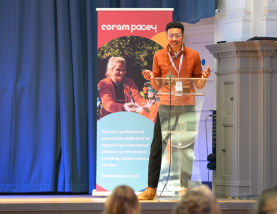
In his recent talk at the Coram PACEY conference on inclusion, equity and belonging, early years lecturer and former practitioner Shaddai Tembo offered rich insights into what these ideas really mean in practice for early years educators. This blog shares his key messages for childminders, helping you reflect on why inclusion is essential and how you can strengthen it within your home‑based setting.
By Zara Smith
Children notice difference from a very young age
A common misconception is that children are “too young” to think about race, gender, or other differences or that talking about these topics’ forces adult ideas onto them. But research and practice tell a very different story.
Shaddai explains that babies and toddlers already notice differences between people. If we don’t guide them through this curiosity with open, positive conversations, biases can develop beneath the surface. Children begin to categorise people early on, and without support, this can lead to harmful stereotypes or exclusion later in life.
This means that the childminder’s role is not to avoid conversations about difference but to gently guide them. When a child says something curious such “Why is his hair curly?” or “Why does she wear a headscarf?”, it’s a golden opportunity to expand understanding, celebrate diversity, and normalise difference.
Inclusion isn’t an “add‑on”, it’s a daily mindset
Inclusion, equity and belonging often get reduced to “a few diverse books on the shelf” or “celebrating a festival once a year.” But true inclusion is something much deeper.
Shaddai reminds us that:
- Inclusion is about making every child and family feel seen, valued and understood.
- Equity means giving each child what they need to thrive, not giving everyone the same.
- Belonging is the emotional glue that helps children feel safe, confident and connected.
These aren’t tasks to be ticked off a list. Rather they must be woven into everyday practice, from the way parents are greeted at the door, to the conversations that are had during snack time, the play materials that are provided, and the expectations you hold for each child.
Small biases lead to big differences
One of the most important messages from the talk was this: Inequality doesn’t start at school, it starts much earlier, and usually unintentionally.
Shaddai gave powerful examples of how subtle biases influence children’s opportunities. For instance:
- Assuming boys “prefer” outdoor rough‑and‑tumble play
- Expecting migrant children to have lower abilities
- Letting certain groups dominate spaces or activities without meaning to
Over time, these unnoticed habits shape how confident children feel, what they are encouraged to try, and how they are assessed.
The message for childminders is clear: Reflective practice is your greatest tool. Pause and ask yourself:
- Why do I expect certain behaviour from this child?
- Do my routines work well for all families?
- Who tends to take up space? Who hangs back?
- Do I respond differently to children depending on gender, culture or language?
These small reflections lead to big changes.
Creating inclusive physical spaces in a home setting
You may think that research about nursery rooms and playgrounds doesn’t apply to a home setting, but the principles absolutely do.
Studies Shaddai shared show that children often gravitate to play spaces along gender lines. For example, boys may dominate central spaces or construction areas, while girls stay around the edges. These patterns aren’t fixed; they’re shaped by the environment and by adults’ expectations.
In your home, try asking:
- Do all children see themselves represented in toys, books and materials?
- Are spaces arranged so that everyone feels welcome to explore every area?
- Do I rotate materials to avoid stereotypical play patterns developing?
You don’t need more space; you need thoughtful choices.
Understanding cultural belonging in your setting
One of the most eye‑opening parts of Shaddai’s talk was an activity showing how everyday Western habits can seem unusual when described differently. It reminds us that everyone’s “normal” is different.
As a childminder, this means learning each family’s cultural expectations by asking open questions about their routines, food, caregiving practices, or celebrations, while making sure your setting truly honours their home languages and traditions, and recognising your own cultural lens and how it might shape the assumptions you bring to your work. For a parent who has recently moved to the UK, your setting might feel very unfamiliar. Inclusion means walking alongside families to understand what childhood looks like for them, not just introducing them to your way of doing things.
Be both proactive and reactive
Shaddai explained that anti-discriminatory practice in early years settings has two essential strands: reactive practice and proactive practice.
Reactive practice involves responding sensitively when a child says something exclusionary or stereotypical. Rather than shutting the conversation down with phrases like “We don’t say that” you might gently ask, “What made you think that?” or suggest, “Let’s talk about it together.” Statements like “People are all different, and that’s wonderful” help guide children towards understanding and respect.
Proactive practice focuses on preparing your environment so that these moments are less likely to arise in the first place. This means using books and toys that represent ordinary diversity, showing people in non-stereotypical roles, encouraging open-ended role play with comments like “Families can look all kinds of ways!”, and offering stories, music, and materials from different cultures. It also involves giving every child the chance to explore all spaces freely.
The more proactive steps you take daily, the less reactive intervention you’ll need.
Childminders are uniquely positioned to lead this work
Childminders enjoy unique advantages over larger settings, including deep personal relationships, small group sizes, strong family partnerships, flexible routines, and the warmth of intimate home-based spaces. These qualities create ideal conditions for nurturing true belonging. Children flourish when they feel truly known and no one is better placed to make that happen than you.
Final thoughts
Shaddai’s central message is that you don’t need to fix society, but you can change the experiences children have in your care.
By embracing inclusion, equity and belonging:
- You give children the confidence to value themselves and others
- You create a place where every family feels welcome
- You challenge inequality at the point where it matters most – the early years
And that’s not “extra work.” It is the work.